
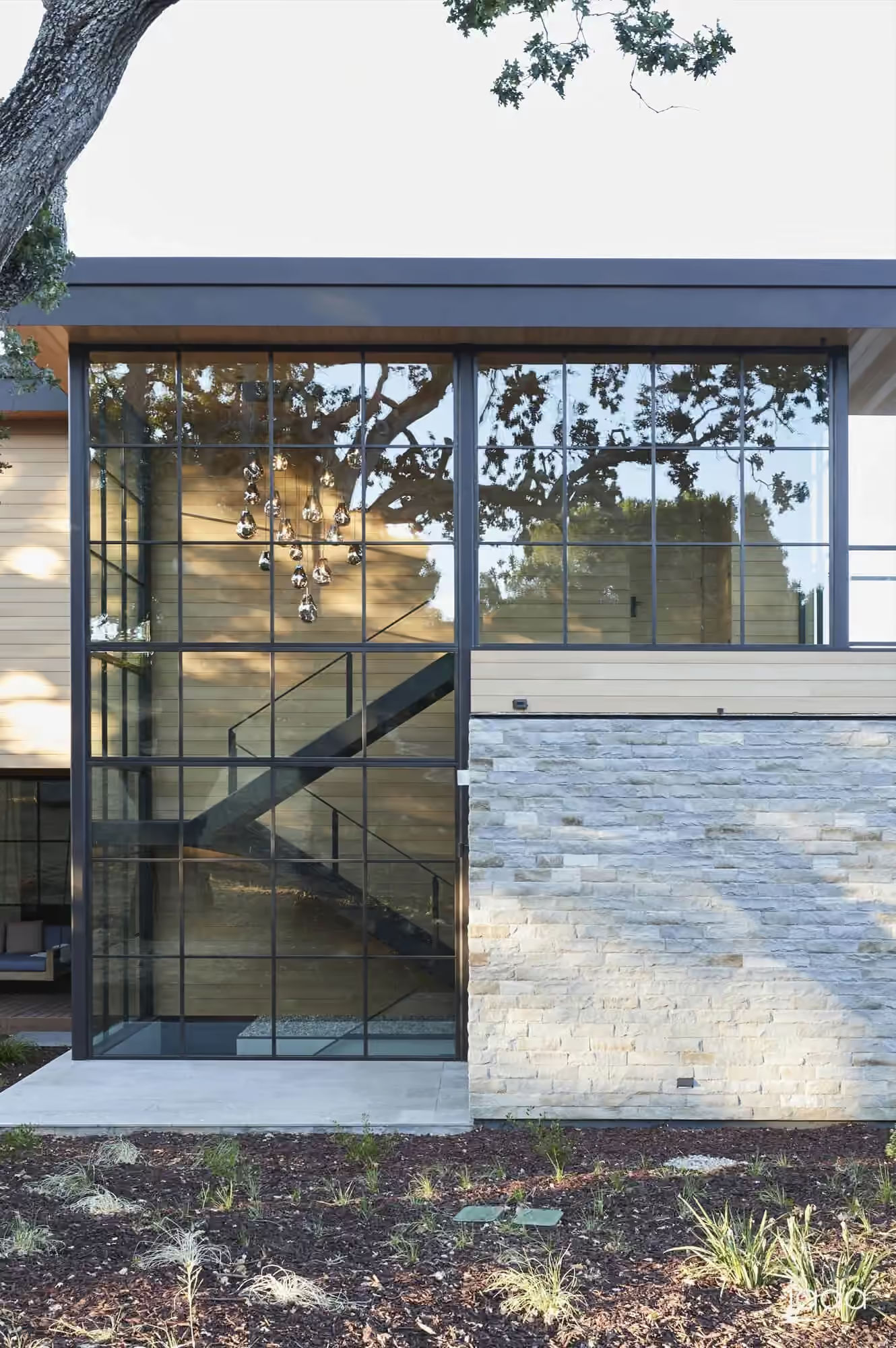
What is a thermally broken steel window?
A thermally broken steel window has an insulating barrier that splits the frame into an outer half and an inner half. Heat has to cross the barrier to move through the frame. Jada builds its steel windows and doors this way, using Secco profiles.
Steel conducts heat well. On a hot Dallas afternoon, an unbroken steel frame can pass that heat inside. A thermal break puts a poor conductor in the path. Jada describes the idea this way: separate the exterior portion of the frame from the interior portion with a non-conductive material.
Our pillar page on steel windows and doors covers the full product range. This guide covers one topic: what the break does, what it does not do, and what to ask.
How is the thermal break built in steel?
Jada says its Secco profiles are roll formed from quality metals, and the two halves are joined with a pressure infused polyurethane thermal barrier. The outer half meets the weather. The inner half meets your room. The barrier sits between them.
Jada also says a polyamide strut adds strength to the joint between the two roll formed halves. That detail matters, because the barrier has to carry load as well as insulate. Ask any maker how the barrier is tested for strength and how it holds up over time.
Jada’s swing line, which covers outswing, inswing, awning, hopper and fixed units, uses narrow sightline Secco OS2 thermally broken steel profiles. Jada does not publish sightline widths, so we use only the words “narrow sightline.”
| Term | Plain meaning |
|---|---|
| Thermal break | A barrier of low-conductivity material inside the frame |
| Thermal barrier | The material that forms the break, here polyurethane |
| Polyamide strut | A strengthening piece that joins the two halves |
| Sightline | The visible width of the frame |
| U-factor | How fast heat flows through the whole unit |
| SHGC | How much solar heat passes through the glass |
For short definitions, see the glossary entries for thermal break and thermally broken steel.
Are thermally broken steel windows energy efficient?
They can be. The US Department of Energy says that if the frame or sash is mostly metal, it needs carefully integrated thermal breaks to minimize conductive heat flow. ENERGY STAR says frame design for aluminum typically includes thermal breaks for the same reason.
The break handles the frame. It does not handle the glass, which makes up most of a window’s area. The Department of Energy says the energy efficiency of a window is primarily a function of its U-factor and its solar heat gain coefficient (SHGC). Both numbers describe the whole unit.
Your NFRC label will show the real values for your unit, so ask for it before you order.
To read a label, use our guides to the NFRC label and to SHGC and U-factor for Texas. Glass choices, including low-E coating, are in our glass options guide.
What does a thermal break change in Texas heat?
In a cooling-heavy climate like North Texas, the break reduces how much heat conducts through the metal into your room. The Department of Energy says warm-climate buyers should look for low SHGC to reduce unwanted heat gain, so glass still leads the decision.
Here is a simple way to think about it:
- The glass decides how much sun heat enters (SHGC) and how much heat leaks through (U-factor).
- The frame decides how much heat the metal conducts around the glass.
- The thermal break limits that frame conduction.
- The spacer at the glass edge limits heat loss at the perimeter. See warm-edge spacer.
- Good installation limits air leakage around the unit.
On the last point, the Department of Energy says good installation practices will minimize air infiltration around fenestration products. A great window installed poorly still leaks.
Do not expect a specific savings number from a frame feature. Savings depend on your house, your glass, which way each wall faces, and how you run your air conditioning. Ask your supplier for the NFRC values and for a layout that shows window orientation.
Does a thermal break stop condensation?
Jada says condensation is also inhibited when using profiles with a thermal break. The Department of Energy lists condensation resistance as a separate NFRC rating, so ask for it when it is available.
Cold mornings and humid air can still create condensation in North Texas. The Department of Energy says excess condensation over time can damage window components and surrounding walls. If a room has a pool, spa or heavy humidity, tell your supplier so they can check the details.
Do thermally broken steel windows rust?
Steel can rust if the finish fails, and a thermal break does not change that. The finish system is what protects the metal. Jada says all its steel components are fully zinc coated after final welding, drilling and machining. It then applies a patina finish, or Tnemec color matching in a durable polymer paint for opaque colors.
Ask these questions about any steel finish:
- Is the zinc applied after welding and machining?
- Is the top finish a patina or a paint?
- How do I repair a scratch?
- Which cleaners are safe?
- What does the written finish warranty cover?
Jada’s pages we reviewed list no product warranty, and Honey Rock publishes none of its own. Get warranty terms in writing before you order.
Does the thermal break help with noise?
Not directly. Sound depends on glass thickness, laminated layers, air gaps and seals. The thermal break is an insulation feature. If street or highway noise matters, ask for a sound rating for the whole unit and talk through laminated glass options.
We cannot cite matching sound ratings for Jada steel from the pages we reviewed, so we will not promise a decibel number. Ask for test data for your exact configuration.
What should I ask before I buy?
Ask for the same documents from every supplier, then compare them side by side. This list works for steel, aluminum or any metal system.
- A section drawing that shows the thermal barrier and the strut.
- The NFRC label values (U-factor, SHGC, visible transmittance) for the exact unit.
- The glass makeup: pane thickness, gap, coating, gas fill and spacer.
- The finish system and its written warranty.
- The maximum size and sash weight for your openings.
- How the unit is flashed and sealed at the rough opening.
- The lead time and shipping method.
If steel and aluminum are both on your list, read the steel vs aluminum guide. If sightline matters most, read the slim-profile windows guide.
How do thermally broken steel frames compare with other frame types?
ENERGY STAR describes each framing material in plain terms, and a short table helps you see where metal fits. The quotes below come from its page on what makes a product ENERGY STAR certified.
| Frame material | What ENERGY STAR says |
|---|---|
| Fiberglass | Frames are strong, durable, low maintenance, and provide good insulation. |
| Vinyl | Frames are low maintenance and provide good thermal insulation. |
| Aluminum | Frame design typically includes thermal breaks to reduce conductive heat loss through the metal. |
| Wood | Frames are strong, provide good insulation, and are generally favored in historical neighborhoods. |
ENERGY STAR does not list steel on that page, so judge steel by its NFRC label and its thermal break, not by a category. The Department of Energy also lists framing in non-conductive materials such as wood, vinyl or fiberglass as one way to lower the U-factor. A metal frame can still perform well when the break is designed in.
For a full comparison of frame families, read our frame materials guide.

What else besides the break lowers heat flow?
The Department of Energy lists the energy-saving features that lower the U-factor: two or more panes, low-emittance (low-E) coatings, argon or krypton gas between the panes, and non-conductive frame materials. A good steel window uses several of these together.
Each one has a glossary entry:
- Insulating glass unit: the sealed glass sandwich.
- Argon gas fill: a gas between panes that slows heat flow.
- Low-E coating: a thin metal layer on the glass.
- Warm-edge spacer: the strip at the glass edge.
Ask your supplier which of these the quote includes. A thermally broken frame with plain clear glass can leave a lot of performance on the table. A frame with a break and a well-chosen low-E glass can perform far better. We cannot give a number without the NFRC label, so ask for the label.
How can I tell if a quote describes a real thermal break?
Look for the barrier by name. A quote should say what the barrier is made of and where it sits in the profile. Phrases like “energy efficient frame” or “high performance steel” tell you nothing. Ask for the system name and a section drawing.
Then compare the NFRC values for the whole unit. A real break should show up as a sensible U-factor on the label, once the glass is accounted for. If the label is missing, ask why. Our NFRC label guide shows what a complete label lists.
A short red-flag list:
- The quote names no profile or system.
- The quote gives no glass makeup.
- The quote gives no NFRC values.
- The seller will not share a drawing.
- The seller promises a savings figure without your house details.
If you see two or more, slow down and ask for the missing documents in writing.
Next step
Send us your plans and your orientation, and we will help you ask the right questions about glass, frame and finish. Start at the steel windows and doors page, then start your project or call (214) 484-9982.
Questions people ask
What is a thermally broken window?
It is a metal window with a non-conductive barrier that separates the outer frame from the inner frame. The barrier slows heat flow through the metal. Jada builds its steel units this way, joining two roll formed halves with a polyurethane thermal barrier.
Are steel windows energy efficient?
A steel window with a thermal break and well-chosen glass can perform well. The US Department of Energy says a mostly metal frame needs carefully integrated thermal breaks. Check the NFRC label for the exact unit, because glass and spacer matter as much as the frame.
Do thermally broken windows reduce heating and cooling bills?
A lower U-factor means less heat flows through the window, and in warm climates a low SHGC reduces unwanted heat gain, per the US Department of Energy. A thermal break helps the frame side of that. Savings depend on your house, glass and orientation, so we do not promise a number.
Are thermally broken windows better for noise reduction?
Noise depends mostly on glass thickness, laminated layers, air gaps and seals. The thermal break itself is not a sound product. If quiet matters, ask for the sound rating of the whole unit and for glass options. Jada and Bertrand do not publish matching acoustic data for steel.
Do steel windows rust?
Steel can rust if the finish fails. Jada says its steel components are fully zinc coated after final welding, drilling and machining, then given a patina or painted finish. Ask for the finish warranty in writing, and tell your supplier about pools and irrigation spray.
Terms on this page
Sources
- Jada Windows: Thermal Design
- Jada Windows: Thermal Design (joining method)
- Jada Windows: Swing windows and doors
- Jada Windows: Finish Options
- US Department of Energy: Purchasing Energy-Efficient Residential Windows, Doors, and Skylights
- US Department of Energy: U-factor
- US Department of Energy: Hot Climate Strategy
- ENERGY STAR: What makes it ENERGY STAR?
- Jada Windows: Thermal Design (condensation)
- US Department of Energy: Condensation Resistance
- US Department of Energy: Energy-saving features
- ENERGY STAR: Fiberglass frames
- ENERGY STAR: Vinyl frames
- ENERGY STAR: Wood frames
Written by Honey Rock Window and Door and checked against the sources above on November 5, 2026. Product specifications and city rules change, so check the linked page before you act.